The Supercomputers Era: My God, It’s Full of Flops
Explorers of the Earth & Computing | By Laurent Clerc, CTO HPC and Cloud Solutions | Blog 3 | Aug 11, 2026
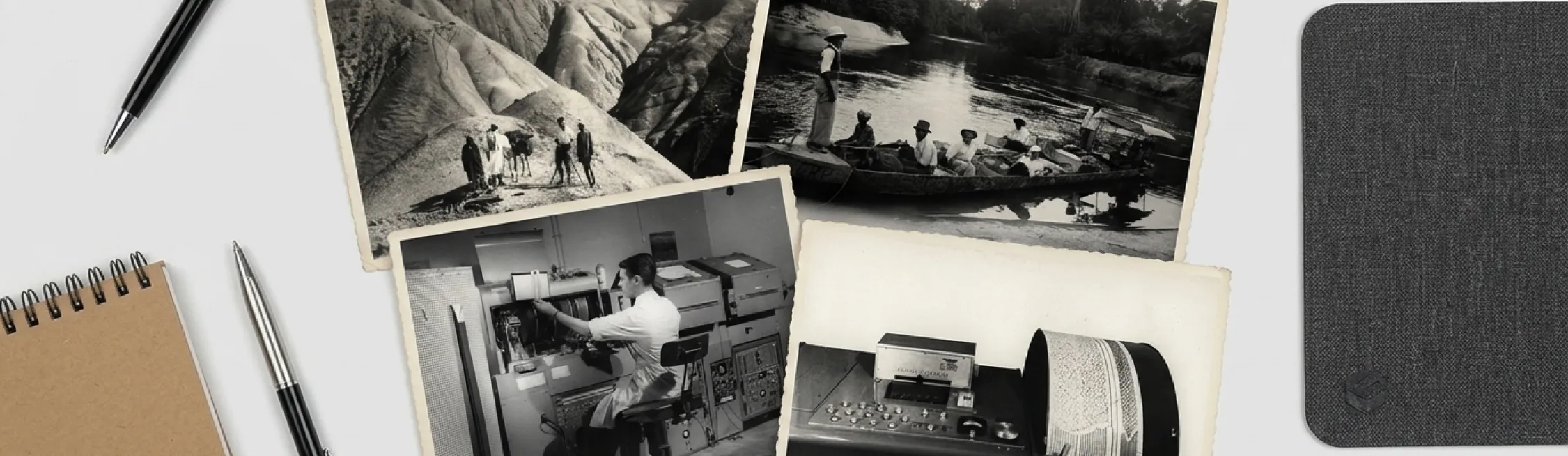
In my last post, I covered the PerkinElmer era, the point where digital machines replaced analog kit and imposed a new discipline on how we worked. Today, I will attempt to share the transformative experience that the first generation of supercomputers had on our business - and the life and career of many of us.
Because when Cray entered the picture, big, heavy and expensive, nothing else quite looked like that. We were no longer talking about a useful computer in the corner of a processing center; we were talking about supercomputers that changed the scale of what CGG (now Viridien) could do.
They also changed the culture. A Cray was not something you bought casually. It was a strategic commitment. Once you had one, the machine had to earn its keep, and everybody around it felt that pressure, from management and facilities teams to software engineers and geophysicists.
These systems were a significant investment. You didn’t just try things on a Cray to see what happened, you chose carefully what deserved that level of horsepower, because every run had a – possibly catastrophic – cost attached to it (come to think of it, a bit like in the Cloud…). You had to be one of the chosen few to even be allowed to log onto a Cray: everything ran as batch workload, submitted on front-end machines in batch queues and properly vetted before getting near any amount of Cray memory, storage or processors.
Worthy of the Machine
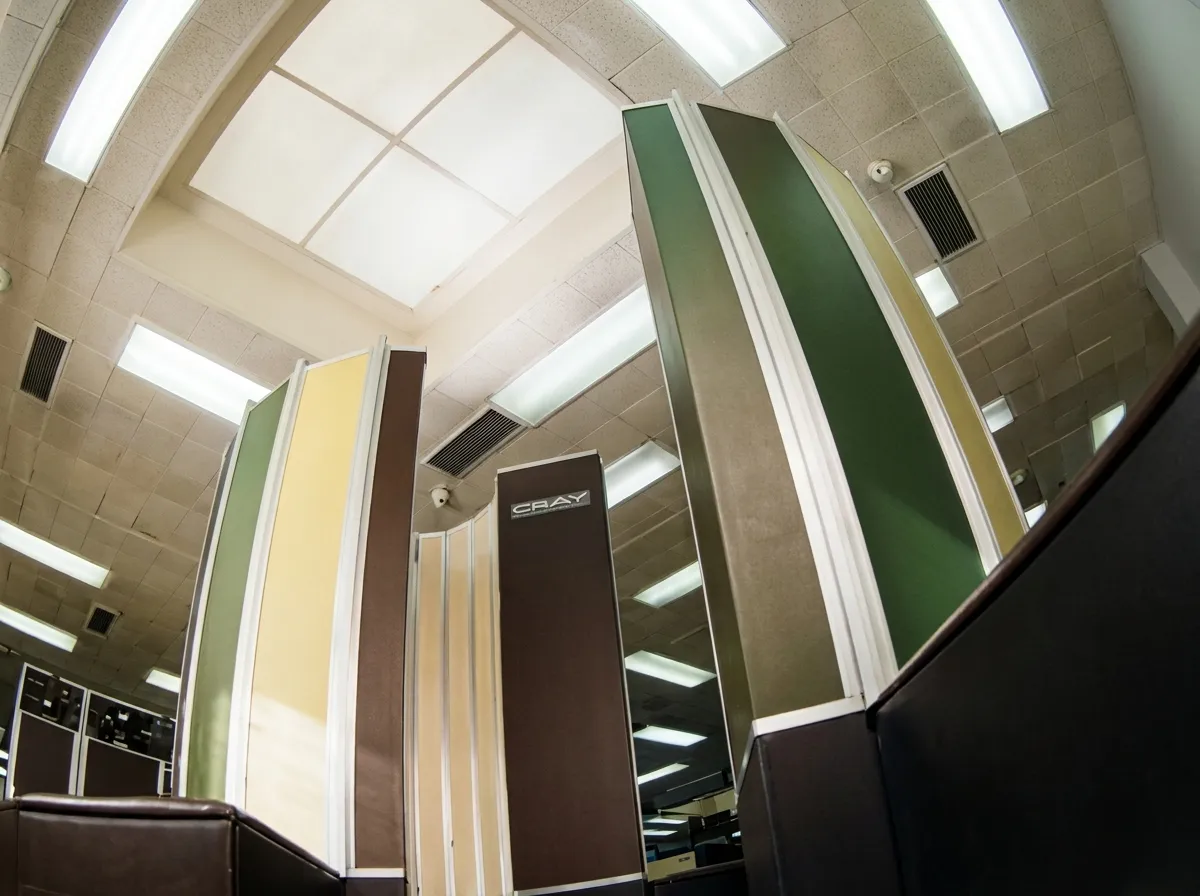
The machines were the supercomputers built by Cray Research, and they came to define high-performance computing through the 1980s and into the 1990s. They were vector processing systems, later equipped with large solid-state storage devices and multiple CPUs, which meant they could be extraordinarily powerful, but only if your code was written to take advantage of that architecture. This is where one of Viridien's lasting skillsets started: optimizing code for the machine, which we can do because we own the whole software stack and understand the hardware underneath it.
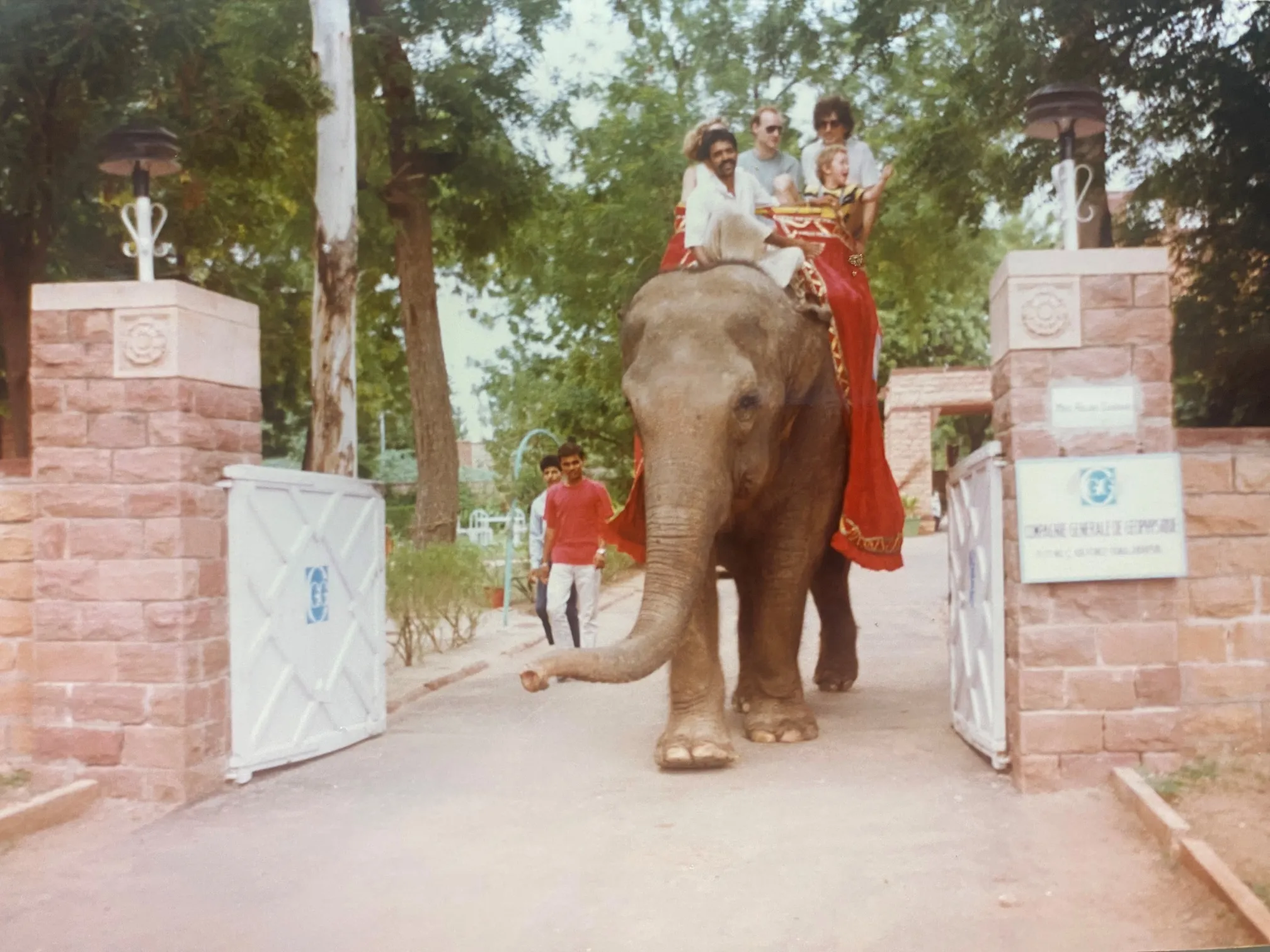
Now, that is all very relative, since the Cray-1 produced about 160 MFlops peak, and the Cray-2 1.9 GFlops, all while using 100 to 200 kW: an iPhone 15 Pro today produces about 2 TFlops using a tiny battery. So yes, things have changed. But then, a Cray was the pinnacle of what computing could be, and just being in the same room as one was an experience I can still remember. People would get their pictures taken with the machines: early selfies I suppose...
But perhaps now is a good time to say a word about what seismic imaging is all about, because it explains why compute was never just a support function in this business. The goal is to model the subsurface in three dimensions: to image layers of rock, their geometries, their folds and faults, across cubic kilometers of volume with the best possible resolution. Those layers were mostly deposited flat at the bottom of ancient seas and basins. The water retreated, the layers got folded, thrusted, and twisted by the slow movements of the Earth over geological time, and what you are left with underground is structure that can be of significant complexity, often hiding most of what is commercially interesting.
Seismic imaging works by sending sound waves into the ground. Those waves penetrate, reflect, refract, and diffract through the layers, and eventually re-emerge at the surface carrying the imprint of where they have been. What comes back is an exceedingly small signal, heavily distorted, buried in noise; you need enormous volumes of redundant data just to see anything at all. We call the recording of those returning signals at fixed intervals and locations seismic traces, and what you are trying to reconstruct from those traces is the actual structure of the subsurface, a problem that gets harder the deeper you go and the more complex the geology.
In the early 90s the seismic migration was becoming a routine tool: taking the recorded traces and moving their energy back to where the reflectors belong, using a velocity you estimated and adjusted by hand. It was not yet about simulating how sound moves through the earth; it was arithmetic, an enormous amount of it, repeated across the volumes of data a survey produces. That alone was enough to strain a Cray, because the pressure came from the number of recordings and the cost of pushing each one through the machine. This is where the code-optimization skill came from, and why it mattered: well-written code and naive code were the difference between a job that finished and a job that eventually had to be killed. Time and money wasted, a lot of unhappy people.
What came later was a different problem. Wave-equation migration, and eventually full inversion, meant you stopped picking a velocity and started solving for the Earth itself, iteratively, with the propagation physics in the computation rather than off to the side; the more precise the model, the more focused the image. That raised the compute demand by orders of magnitude, and it belongs to a later part of this blog series. The machine in that photo was already working hard on what would, in hindsight, look like the easy version of the problem.
It’s a game with no ceiling requiring user insight – the geophysicists – as well as software and processing resources. Being better at it, consistently, at industrial scale, is what has led to Viridien's current standing in the industry.
For CGG, that was the real turning point. We had already been early users of industrial computing, long before most people would have called it that. But a Cray was different. It was not just a faster machine. It was a new operating model. You planned for power, cooling, specialist support, and workload-sharing. You organized people around it. You justified it to leadership. And you started to think of compute as a strategic capability rather than a technical utility. For good or for bad, the cost was now in the machine, not the humans serving it — a shift that will feel familiar to anyone watching what is happening with AI infrastructure today. But that is a story for much later in this series.
If the earlier era introduced discipline, the Cray era introduced scale. These were multi-million-dollar bets. Buying one could mean Board discussions, CFO scrutiny and CEO-level attention, because the decision did not stop at the hardware. It brought with it facilities changes, maintenance commitments, software work and very real business risk.
Life at the Edge
If you can remember 1990, very (very!) basic Internet, cell phones the shape of a shoe box… managing a large worldwide fleet of emerging supercomputers was never boring.
By the time I joined, CGG already had a Cray in Massy, south of Paris, and later another one in London near Heathrow airport. Those machines were part of a much bigger CGG story. We were already building out our processing capability around the world, supporting land crews, seismic vessels and regional centers, but the Cray sat at the top of that world as the machine you used when the problem was big enough to justify it.
One story from that period has stayed with me because it captures the slightly surreal side of living with frontier technology. We had one of our Crays in London, right next to Heathrow, close enough that when the machine started behaving oddly, people genuinely wondered whether the airport radar at the end of the runway was somehow interfering with it. It turned out not to be the cause as, if I recall correctly, it was a cable that was just a bit too short inside the machine. The machines were all cabled on site by specially trained crews… But the fact that it sounded plausible tells you a lot about the era. We were operating at the edge of what these systems could do, and when you live at that edge, the real world has a habit of intruding in unexpected ways.
Worth noting, we also used similar systems from Convex, in Richardson, Texas. Those mini-Crays were smaller, somewhat less expensive, and easier to deploy, but still multi-processor vector machines with one twist: they used GaAs (gallium arsenide) instead of silicon for the C3 and C4 machines. This looked like a promising technology, but as sometimes happens when a mainstream product is already massively dominant, GaAs did not prevail, at least not for computers. We had quite a few Convex, in places like Houston or Muscat in Oman and maybe a dozen of smaller regional sites around the world. The seismic vessels and land crews also had their own processing capability for QC. That was partly because data had to stay in country in many places, partly because the internet was either absent or far too limited to move seismic volumes around, and partly because having people and equipment in country mattered commercially. So, while the Cray represented the top end of the stack, it sat inside a much broader network of compute, people and local delivery.
Our in-house processing software at the time was called Geovecteur because it was doing Geophysics on Vector processors. So, I am sure you can guess what the name of the software became when we moved to Clusters late in the 1990’s... With that, we learned to optimize our software on more than one platform, to give us the flexibility of choosing the right hardware for the right application: something that is still true today and is a significant commercial advantage for Viridien.
The CFO Started Asking Questions
The first time I saw senior leadership discuss a Cray acquisition, the interesting thing was that the conversation was not really about FLOPS. You would expect it to be. It was not. It was about what this machine would change for the business and whether that justified the investment:
- Throughput: could we process more, faster, and turn that into an advantage in the market?
- Imaging quality: could better compute help us build better models and give clients more confidence in what they were seeing?
- Reputation: in those days, owning a Cray said something about who you were. It signaled that you were serious, and it attracted talent.
- Operational commitment: did we really want to take on the cost of the machine, the maintenance, the facilities changes and everything else that came with it?
Once you had spent that kind of money on hardware, utilization stopped being a technical metric and became almost a moral obligation. A Cray sitting idle felt wrong. You could almost hear the money evaporating. Every cycle mattered. Every rerun mattered. Every inefficiency mattered:
- Throughput became commercial: if we could run more processing, we could deliver more value.
- Scheduling became financial: priorities and queue discipline were no longer just operational details.
- Code efficiency affected margins: vector machines rewarded careful programming, so better software had a direct business impact.
You can still see that mindset at Viridien today. While it is tempting for an IT team to see only the technology aspect of things, the idea that HPC has to convert time, energy and hardware into client value did not appear recently. It was already there in the Cray years.
A Different Kind of Legacy
It was not just about one spectacular machine at the early dawn of the computer era we all take for granted today. It was about rapid adoption of technologies at scale and learning how to connect optimized compute to a global operating model.
A Cray brought geophysicists, coders, operators, facilities teams, procurement people and senior management into the same conversation. That may sound obvious now, but it was not obvious then. Before that, those groups could operate quite separately. A machine like this forced a shared dependency and, with it, a shared culture.
You could feel it in the data hall. You had programmers rewriting code for vector processing, operators watching queues, vendor engineers with specialist tools, facilities people worrying about cooling, and geophysicists trying to push the algorithms further. That combination of scientific ambition and practical engineering is still very familiar to me now.
Still, there is an irony in the Cray era that only becomes visible in retrospect. When you have made a fifty-million-dollar commitment, the organizational instinct is to leave it in place, let the vendor maintain it, and extract value for as long as possible. In-house IT involvement is minimal, and that worked, for a while.
But as the 1990s rolled on, the market opened. We had Crays, Convex machines, and then several newer platforms appearing in quick succession. At one point we were supporting five or six architectures simultaneously in dozens of countries and vessels. That changed everything. Benchmarking became serious work. Supply chain decisions became strategic. Teams formed around testing, integration, deployment, support, and software portability.
The comfortable model of one vendor, one machine, one maintenance contract was over, and what replaced it was considerably more demanding and considerably more interesting. That complexity is what drove the creation of an industry-leading HPC team at CGG, a team that a couple of us had the privilege to shape and lead through the many technology changes that led us to today’s AI systems. More about that in my next episodes.
Viridien may now be working with very different hardware, but I still recognize the same instincts: be early, be practical, and make technology serve science. In that sense, the Cray years were not a detour. They were the point where many of the habits we still rely on today became visible.
That, more than anything, is the legacy of the Cray era.
Got a question about our early field computing days?
Laurent Clerc,
CTO, HPC and Cloud Solutions